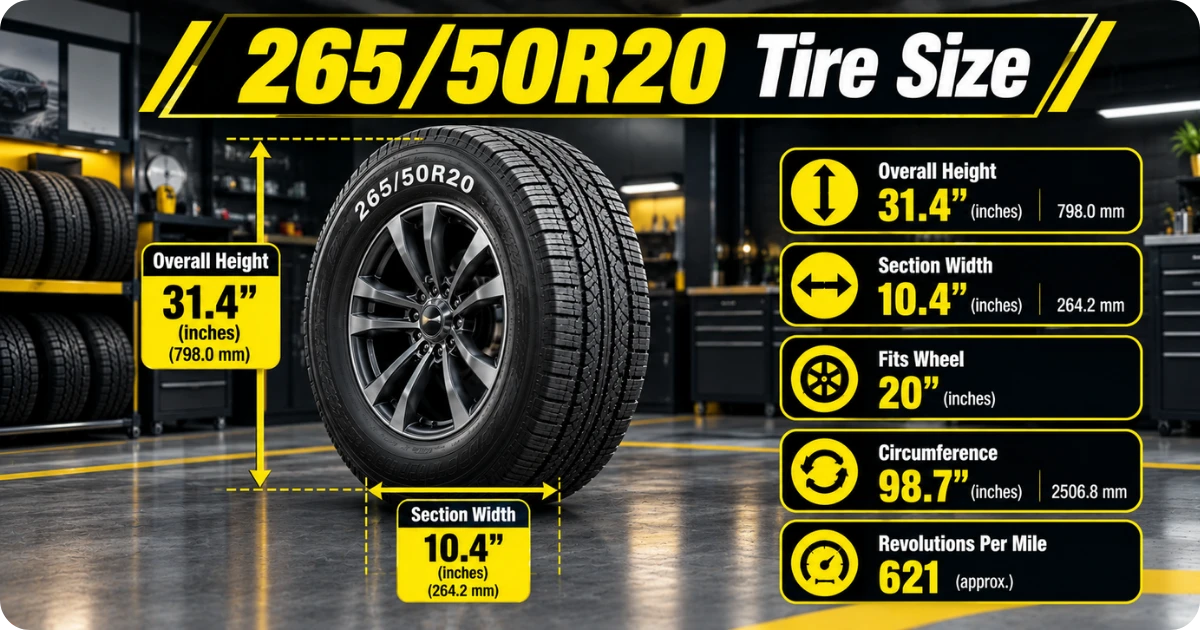
The 265/50R20 tire size is a radial tire that is about 10.4 inches wide and 30.4 inches tall. It fits a 20-inch wheel and is usually approved for 7.5 to 9.5 inch rim widths.
This guide covers the 265/50R20 tire dimensions, equivalents, and fitment checks. The numbers are calculated, so always confirm them against your vehicle placard and the tire manufacturer’s specs.
What Does 265/50R20 Tire Size Mean?
How to Read 265/50R20 Tires
- 265 is the section width in millimeters.
- 50 is the aspect ratio. The sidewall height is 50% of the width.
- R means radial construction.
- 20 is the wheel diameter in inches.
Here is the math: 265 mm × 0.50 = 132.5 mm. That equals about 5.2 inches of sidewall. You may also see this size written as 265/50/20 or 265 50 20 tire size. They all mean the same thing.
Where to Find Your Tire Size
Check the tire sidewall first. You can also look at the driver’s door placard or the owner’s manual. The placard shows the size the vehicle maker approved.
Why the Service Description Matters
The size alone is not the full spec. Look for the service description after it, such as 111T XL or 107H SL. Two tires can share the same size and still carry different loads. Always match the full marking, not just the numbers.
More Post: 225/55R17 Tire Size
265/50R20 Tire Size in Inches and Key Specs
| Spec | Inches | Millimeters | Centimeters |
|---|---|---|---|
| Overall diameter | About 30.4″ | About 772 mm | About 77.2 cm |
| Section width | About 10.4″ | About 265 mm | About 26.5 cm |
| Sidewall height | About 5.2″ | About 132 mm | About 13.2 cm |
| Circumference | About 95.6″ | About 2,428 mm | About 242.8 cm |
| Revolutions per mile | About 663 | About 412 per km | About 412 per km |
| Wheel diameter | 20″ | 508 mm | 50.8 cm |
Rim Width for 265/50R20 Tires
Most makers approve 7.5 to 9.5 inches. The measuring rim is only the reference for published sizes. A narrow rim gives the tire a rounder shape with more sidewall flex. A wide rim gives a squarer shape and a stiffer feel.
Load Index and Speed Rating
The load index tells you the maximum weight one tire can carry.
- 107 carries up to 2,149 lb per tire.
- 111 carries up to 2,403 lb per tire.
- T is rated for up to 118 mph.
- H is rated for up to 130 mph.
- V is rated for up to 149 mph.
XL stands for Extra Load. SL means Standard Load. It is a load rating. It does not count the plies in the tire.
Max Pressure vs Recommended Pressure
A sidewall figure like 50 psi is the maximum load pressure. Your recommended tire pressure is on the door placard. The U.S. TPMS warning light comes on when pressure drops 25% or more below that number.
More Post: 275/55R20 Tire Size
265/50R20 Tire Size Equivalents and Alternatives
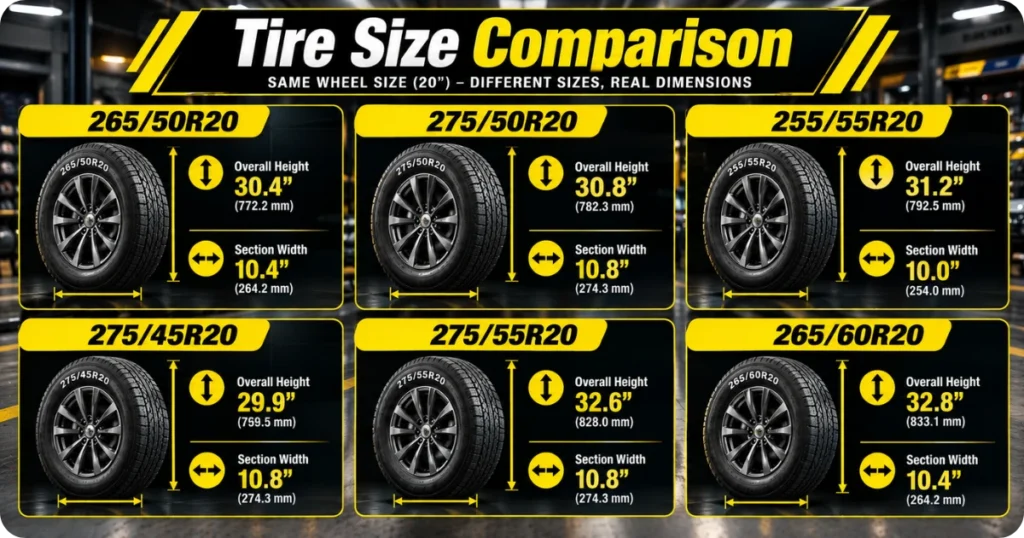
Tire makers and mechanics use the 3% rule. Keep the new overall diameter within 3% of the old one. This keeps the speedometer, odometer, and gearing close to stock.
265/50R20 vs 275/45R20
The 275/45R20 is about 29.7 inches tall. That is 2.3% smaller than the 265/50R20. It sits inside the 3% rule. It is also wider, at about 10.8 inches.
A smaller tire makes the speedometer read high. When your dash shows 60 mph, you are really going about 58.6 mph.
Other Close 265/50R20 Equivalents
| Size | Diameter | Width | Change |
|---|---|---|---|
| 265/50R20 | 30.4″ | 10.4″ | base |
| 275/50R20 | 30.8″ | 10.8″ | +1.3% |
| 255/55R20 | 31.0″ | 10.0″ | +2.0% |
| 275/45R20 | 29.7″ | 10.8″ | −2.3% |
| 275/55R20 | 31.9″ | 10.8″ | +4.9% |
| 265/60R20 | 32.5″ | 10.4″ | +6.9% |
The last two sizes break the 3% rule. With the 275/55R20, a dash reading of 60 mph means about 62.9 mph in real life. With the 265/60R20, it means about 64.1 mph.
When a Different Size Is a Bad Idea
Skip a swap in these cases:
- The load index is lower than the original.
- The tire rubs the fender or suspension at full turn.
- The new width does not suit your rim width.
- Your ABS, traction control, or speedometer needs recalibration.
Have a tire professional check the combination before you buy.
More Post: 285/45R22 Tire Size
How to Choose the Right 265/50R20 Tires
Fitment Checklist
- Match the size on the door placard.
- Meet or beat the original load index and speed rating.
- Confirm your wheel width is in the approved range.
- Check fender clearance and suspension clearance.
- Check wheel load capacity as well as tire load.
Best 265/50R20 Tire Types by Driving Need
- All-season: best for daily commuting and mixed weather.
- Highway or touring: best for a quiet ride and long tread life.
- All-terrain: best for gravel, dirt roads, and light off-road use.
- Summer performance: best for dry grip and sharp handling.
- Winter: best for snow, ice, and cold temperatures.
Most 265/50R20 options on the market are truck/SUV all-season and all-terrain tires.
265/50R20 Tire Price Range
Listings show about $115 to over $500 per tire. Price depends on tire type, brand, and warranty. Winter and ultra-high-performance tires usually cost more. Replace all four tires when you can. If not, replace them in matching pairs.
More Post: 255/50R20 Tire Size
FAQ’s About 265/50R20 Tire Size
What do the numbers in 265/50R20 mean?
265 is the section width in millimeters. 50 is the aspect ratio. R means radial. 20 is the wheel diameter in inches. In real terms, the tire is about 30.4 inches tall and 10.4 inches wide.
What wheel width is approved for 265/50R20 tires?
Most makers approve 7.5 to 9.5 inches. The wheel must also be 20 inches across. It must suit your vehicle and its load needs.
What does 111T XL mean on a 265/50R20 tire?
111 is the load index, which equals 2,403 lb per tire. T is the speed symbol, rated up to 118 mph. XL means Extra Load. Use the full marking when you match a replacement.
Is 50 psi the pressure I should run?
No. 50 psi is the maximum load pressure on some tires. It is not a recommended pressure. Use the number on your door placard.
Will 265/50R20 tires fit any vehicle with 20-inch wheels?
No. A 20-inch wheel is only one requirement. You also need the right rim width, load index, speed rating, wheel load capacity, and clearance.
Is 265/50R20 the same as a 30-inch tire?
Not quite. It measures about 30.4 inches, so it is close. A true 30-inch tire is slightly smaller.

I’m Richard Hayes, a content researcher and writer at TireMeasurements.com, specializing in measurements, tire measurements, tire sizing, wheel fitment, and related automotive topics.