If your car came with this size from the factory, you have hundreds of tire options to pick from. This guide breaks down what the numbers mean, which cars use this size, and how to choose the right tire without the guesswork.
What Does 195/65R15 Mean
Tire Width, Aspect Ratio, and Rim Diameter
The 195 is the tire’s width in millimeters, measured from sidewall to sidewall. The 65 is the aspect ratio, meaning the sidewall height equals 65% of the tire’s width. The R stands for radial construction, the standard build for almost all modern tires.
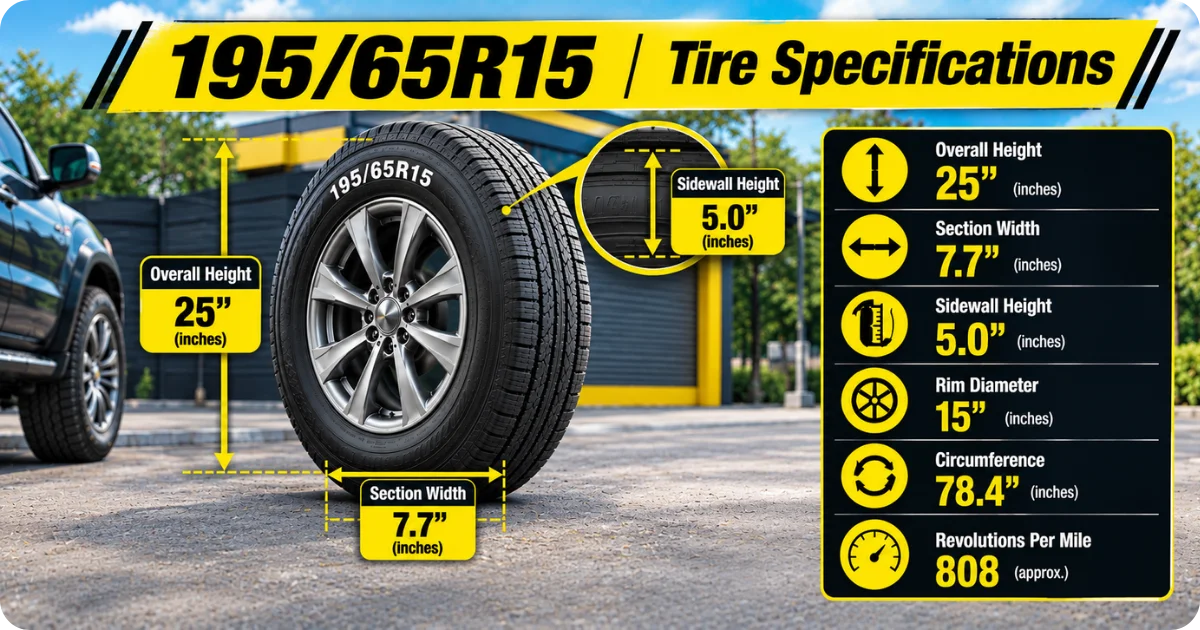
The 15 is the wheel diameter the tire is designed to fit, in inches. So a 195/65R15 tire needs a 15-inch rim, and its sidewall height works out to about 5 inches.
Overall Diameter, Sidewall Height, and Circumference
Once you combine the width, aspect ratio, and rim size, you get the tire’s full overall diameter: roughly 25 inches. This number matters because it decides your ground clearance and how far your car travels with each wheel rotation.
The circumference of a 195/65R15 tire is close to 78.4 inches. That means the tire completes around 808 revolutions per mile. These numbers stay fairly consistent across brands, though small differences in tread design can shift them slightly.
Load Index and Speed Rating Explained
Tires also carry a load index and speed rating, usually printed together, like 91H. The load index (91) shows the maximum weight the tire can carry per wheel. The speed rating (H) shows the top speed the tire is built to handle safely.
A 91H tire can carry about 1,356 pounds per tire and is rated for speeds up to 130 mph. Most daily drivers never approach that limit, but the rating still confirms the tire can handle sustained highway speeds without breaking down structurally.
More Posts: 225/65R17 Tire Size
What Vehicles Use 195/65R15 Tires
Common Cars With This Tire Size
You’ll typically find 195/65R15 as a factory size on compact sedans and hatchbacks such as older generations of the Toyota Corolla, Honda Civic, Volkswagen Jetta, and similar economy-class vehicles.
It’s a size built for light passenger cars, not trucks or SUVs, since it’s designed to carry moderate weight at moderate speeds.
How To Confirm Your Correct Tire Size
Never assume your tire size just because your model is common. Check the tire information sticker inside your driver’s door jamb, or look at the sidewall of your current tires.
Your owner’s manual also lists the correct factory size. This step matters because trim levels within the same model year sometimes use different wheel sizes.
Choosing and Buying 195/65R15 Tires
All-Season vs Winter vs Performance Options
All-season tires are the most common pick for this size. They handle rain, light snow, and dry roads reasonably well, making them a practical year-round choice for most drivers.
Winter tires use softer rubber compounds and deeper tread patterns to grip ice and packed snow. If you live somewhere with real winters, a dedicated winter tire outperforms an all-season tire in cold-weather traction by a wide margin.
Performance tires trade some ride comfort for sharper handling and shorter braking distances. These are less common in this size but exist for drivers who want a livelier feel.
Price Range by Tire Tier
Budget tires in this size generally run $60 to $90 each. Mid-range tires, which usually include better tread warranties and quieter rides, land around $100 to $150.
Premium tires from top-tier brands can run $150 and up, often justified by longer tread life and stronger wet-weather grip. Buying four tires at once rather than replacing them one at a time keeps wear even across all four corners of your car.
Tread Life and Mileage Warranty
Tire manufacturers often list a mileage warranty, ranging from around 50,000 miles on budget tires to 85,000 miles or more on premium options. This number isn’t a guarantee, but it’s a useful signal of how long the tread compound is engineered to last under normal driving conditions.
A higher mileage warranty usually means a harder rubber compound, which can slightly reduce grip in exchange for longer life.
More Posts: 265/70R17 Tire Size
Can You Upsize or Downsize a 195/65R15 Tire
Closest Alternate Sizes
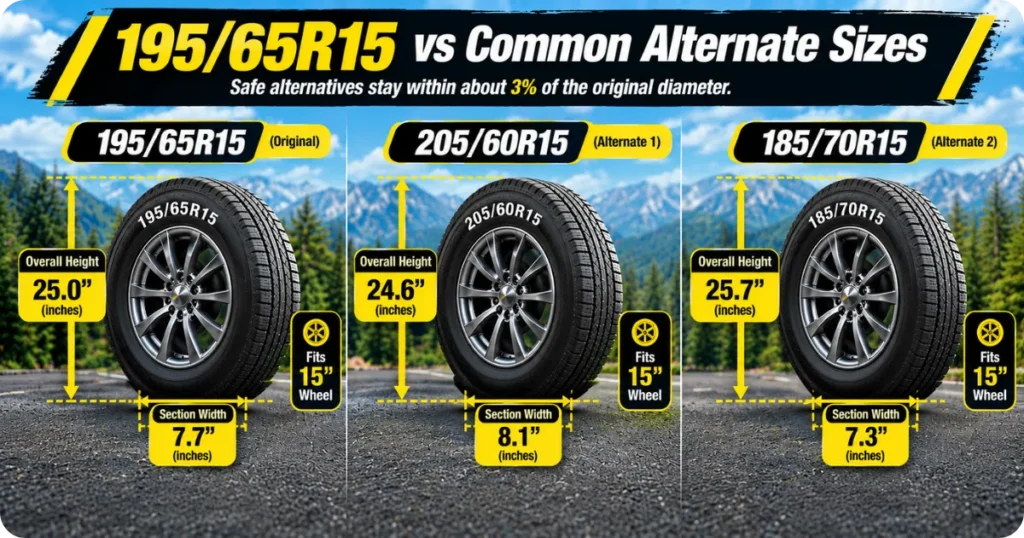
The safest alternate sizes stay within about 3% of the original diameter. For a 195/65R15, common near-matches include 205/60R15 and 185/70R15.
Both keep the overall diameter close enough to avoid major mechanical issues. Straying further than that risks rubbing against the wheel well or throwing off ground clearance.
Why Tire Size Changes Affect Your Speedometer
Your car’s speedometer and odometer are calibrated to your original tire’s circumference. A taller tire makes your car travel farther per rotation than the speedometer shows, so you’ll actually be driving faster than the display suggests. A shorter tire does the opposite.
This same calibration also affects your anti-lock braking system (ABS) and traction control, since both rely on wheel-speed sensors tuned to the factory tire size. Staying within that 3% window keeps these safety systems working the way they were designed to.
More Posts: What Is a 215/60R16 Tire Size
FAQ’s About 195/65R15 Tire Size
What size is a 195/65R15 tire in inches?
A 195/65R15 tire measures about 25 inches in overall diameter and 7.7 inches wide.
What cars commonly use 195/65R15 tires?
This size fits many compact sedans and hatchbacks, including older versions of models like the Toyota Corolla, Honda Civic, and Volkswagen Jetta.
Is 195/65R15 a good all-season tire size?
Yes. Most 195/65R15 tires are built as all-season tires, giving solid year-round performance in rain, dry roads, and light snow.
How much do 195/65R15 tires cost on average?
Prices typically range from $60 to $90 for budget tires, $100 to $150 for mid-range tires, and $150 or more for premium tires.
Can I replace 195/65R15 with 205/60R15?
Yes, in most cases. A 205/60R15 stays within the safe 3% diameter range, making it one of the closest alternate sizes available.
What is the load index and speed rating for 195/65R15?
Load index and speed rating vary by tire model, but a common example is 91H, meaning the tire supports about 1,356 pounds per tire and speeds up to 130 mph.

I’m Richard Hayes, a content researcher and writer at TireMeasurements.com, specializing in measurements, tire measurements, tire sizing, wheel fitment, and related automotive topics.