This size ranks among the most popular fitments for trucks and SUVs across the USA. But the numbers alone don’t tell you if it’s right for your rig. Below, we break down every measurement, compare it to nearby sizes, and show you which vehicles run it stock.
What Is a 265/70R17 Tire Size?
What Does 265 Mean?
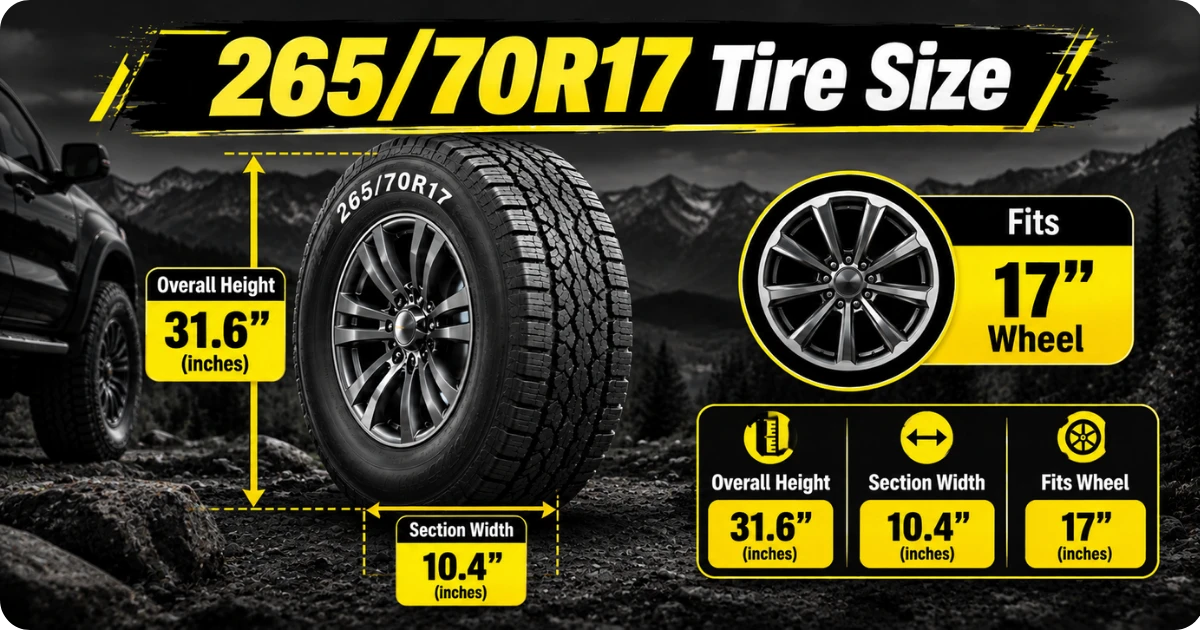
The 265 is the section width in millimeters. Measured sidewall to sidewall, that’s 10.4 inches.
This number stays fixed no matter what rim diameter the tire is built for — a 265-width tire is 265mm wide whether it sits on a 15-inch wheel or a 20-inch wheel.
How the 70 Aspect Ratio Affects Sidewall Height
The 70 is the aspect ratio — sidewall height as a percentage of section width.
- 265mm × 0.70 = 185.5mm
- 185.5mm ÷ 25.4 = 7.3 inches
That 7.3-inch sidewall gives you a cushioned ride.
What Does the R17 Mean in 265/70R17?
“R” stands for radial construction — today’s industry standard.
The 17 is the wheel diameter in inches. This tire only mounts on a 17-inch rim — nothing else.
More Posts: 195/65R15 Tire Size
265/70R17 Tire Size in Inches
| Measurement | Inches |
|---|---|
| Overall Diameter | 31.6 in |
| Section Width | 10.4 in |
| Rim Diameter | 17 in |
| Typical Width Range | 10.3–10.7 in |
Circumference and Revolutions Per Mile
A 265/70R17 tire has a circumference of roughly 99.2 inches. At that size, the tire completes about 638 revolutions per mile. This figure matters more than most drivers realize — it directly affects your speedometer accuracy and gear ratio calculations, which we’ll cover further down.
Recommended wheel width for this size sits between 7 and 9 inches for passenger-rated tires, and 7 to 8.5 inches for LT (Light Truck) versions. Mounting outside that range can cause uneven wear or an unsafe bead seat.
Which Vehicles Fit 265/70R17 Tires?
Several popular US models use this size as factory equipment or a common upsize option, including the Toyota Tacoma, Toyota 4Runner, Ram 1500, Chevrolet Silverado 1500, GMC Sierra 1500, Chevrolet Tahoe, GMC Yukon, and the Ford F-150 (on select trims).
This size sits in a sweet spot — big enough to add a bit of ground clearance and a bolder stance, but not so large that it requires a lift kit or trimming.
More Posts: 225/65R17 Tire Size
265/70R17 vs Other Tire Sizes
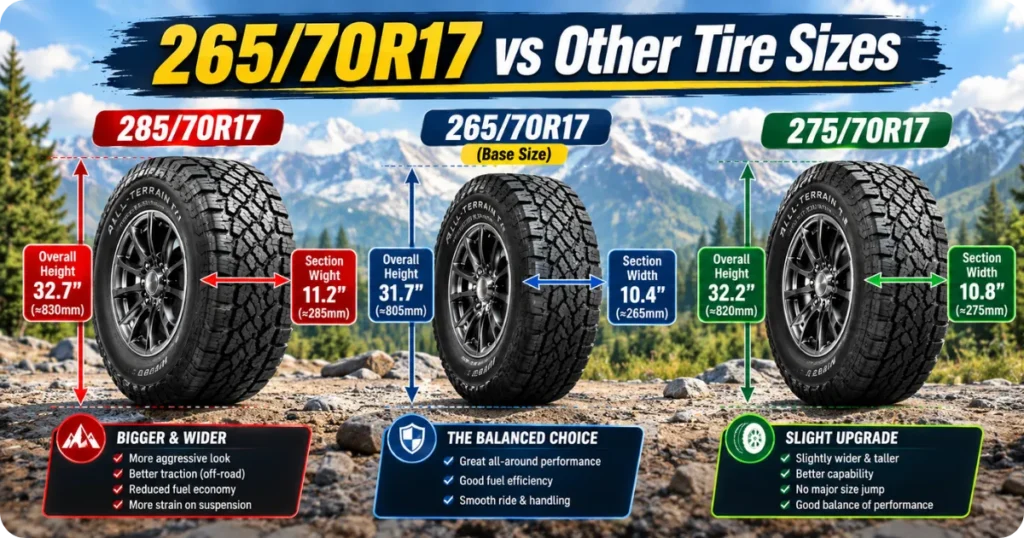
265/70R17 vs 285/70R17
Is 285/70R17 bigger than 265/70R17? Yes. The 285/70R17 measures about 11.2 inches wide and 32.7 inches tall — roughly 0.8 inches wider and 1 inch taller than the 265/70R17.
That extra width and height mean a wider stance, more aggressive look, and better traction for off-roading. The trade-off: reduced fuel economy, more strain on suspension components, and added rolling resistance.
265/70R17 vs 275/70R17
The 275/70R17 lands right in the middle. It’s about 10.8 inches wide and 32.2 inches tall — a modest 0.4-inch width bump and 0.6-inch height bump over the 265/70R17.
If you want a slight upgrade in capability without a dramatic size jump, this is the natural next step.
How to Choose the Best 265/70R17 Tires
Load Range & Speed Rating
You’ll see letters like SL, XL, or LT stamped on the sidewall alongside the size. SL (Standard Load) suits daily driving and lighter loads.
LT (Light Truck) tires carry a reinforced sidewall built for towing, hauling, or heavier cargo. XL (Extra Load) tires handle more weight than SL without the full LT construction.
Speed ratings (letters like S, T, H) indicate the maximum sustained speed a tire is rated for. Most 265/70R17 tires carry an S, T, or H rating — plenty for highway driving in typical passenger and light-truck use.
Best Tire Types for 265/70R17
- All-Terrain (A/T): Best balance of on-road comfort and light off-road grip. Most popular category for this size.
- Highway (H/T): Quieter ride, better fuel economy, less aggressive tread — ideal for daily commuting.
- Mud-Terrain (M/T): Aggressive tread for serious off-roading, but noisier and less fuel-efficient on pavement.
- Winter/Studdable: Built for snow and ice traction in colder climates.
Match the tire type to your actual driving habits — not the one that just looks the toughest.
Speedometer Accuracy, Gear Ratio & Fuel Economy After Upsizing
If your vehicle originally came with a smaller tire. A larger circumference means each wheel rotation covers more ground, so your speedometer will read slower than your true speed — often by 3–4%. At an indicated 65 mph, your actual speed could be closer to 67–68 mph.
Larger tires also change your effective gear ratio. Engine RPM at highway speed typically drops, which can reduce low-end torque and make acceleration feel sluggish.
Fuel economy usually takes a small hit too — commonly a 2–3 mpg decrease — due to the added rotating mass and increased rolling resistance of a larger, heavier tire.
More Posts: What Is a 215/60R16 Tire Size
265/70R17 Tire Size FAQs
What are the dimensions of a 265/70R17 tire in inches?
A 265/70R17 tire measures about 31.6 inches in diameter, 10.4 inches wide, with a 7.3-inch sidewall height.
How does upgrading to 265/70R17 tires affect performance?
Expect your speedometer to read 3–4% slower than actual speed, a drop in highway RPM, and a typical 2–3 mpg fuel economy decrease.
Are 265/70R17 tires the same as 33-inch tires?
No. They measure roughly 31.6 inches — closer to a 32-inch tire, not a true 33.
How does 265/70R17 compare to 275/70R17?
The 275/70R17 is slightly larger — about 0.4 inches wider and 0.6 inches taller.
What should I check before switching to 265/70R17 tires?
Confirm your wheel width (7–9 inches ideal), check vehicle clearance, and consider the impact on speedometer accuracy, gear ratio, and fuel economy.

I’m Richard Hayes, a content researcher and writer at TireMeasurements.com, specializing in measurements, tire measurements, tire sizing, wheel fitment, and related automotive topics.