A 235/40R19 tire is a low-profile, 19-inch fitment. It’s built for sport sedans, coupes, and compact SUVs that need sharp handling.
This guide breaks down what the size means, which cars use it, and how to pick the right 235/40R19 tire for your climate and driving style. No fluff, just the facts you need.
What Does 235/40R19 Tire Size Mean?
Breaking Down the Numbers
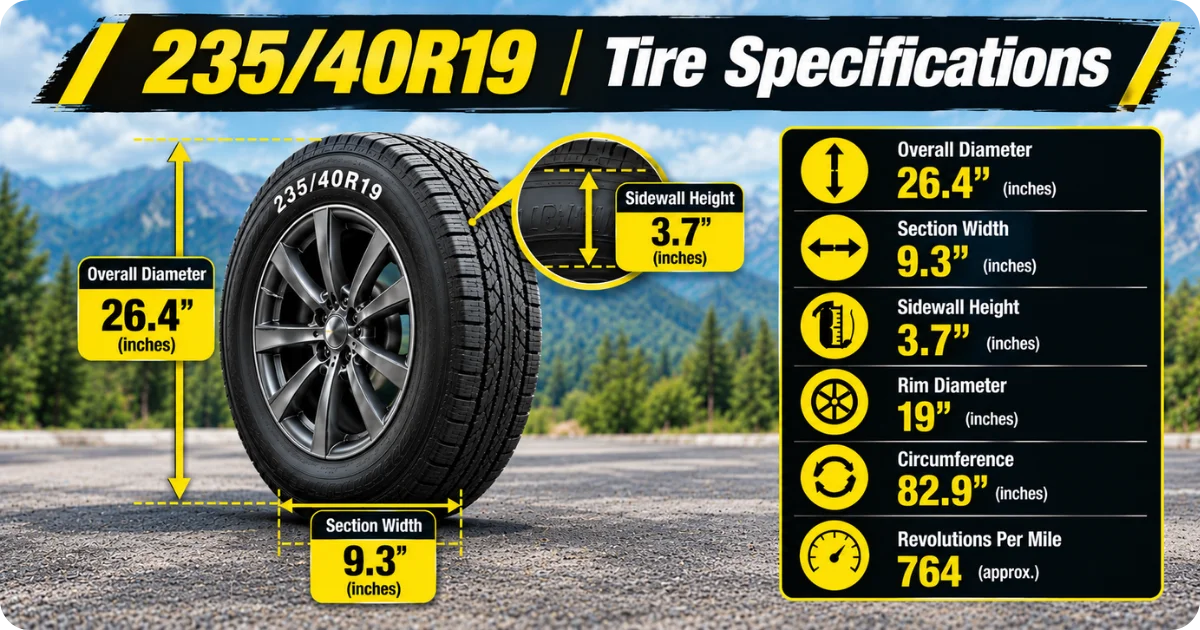
- 235 is the section width in millimeters, measured sidewall to sidewall at the tire’s widest point. That’s roughly 9.3 inches.
- 40 is the aspect ratio. It means the sidewall height equals 40% of the section width. Do the math: 40% of 235mm is 94mm, or about 3.7 inches.
- R stands for radial construction, the standard for nearly all passenger tires sold today.
- 19 is the rim diameter in inches. This tire only mounts on a 19-inch wheel. No exceptions.
235/40R19 in Inches
For US drivers who think in inches, not millimeters, here’s the quick conversion:
- Overall diameter: about 26.4 inches
- Section width: about 9.3 inches
- Sidewall height: about 3.7 inches
- Circumference: about 82.9 inches
- Wheel revolutions per mile: around 764
More Posts: 185/65R15 Tire Size
Which Vehicles Fit 235/40R19 Tires?
Common OEM Vehicles
Cars that use 235/40R19 as factory equipment include the Audi RS4, RS5, and Q2, the BMW 1 Series and 2 Series Gran Coupe, the Alfa Romeo 159 and Brera, the Aston Martin DB9 and V8 Vantage, the Ford Fusion, the Chrysler 200, and the Cadillac CTS and STS.
Always check your door jamb placard first. Trim levels within the same model sometimes run different sizes.
Recommended Wheel Width
The tire’s own comfort zone for rim width sits between 8.0 and 9.5 inches. Mount it narrower, and the tread rounds off, shrinking your contact patch. Mount it wider, and the tread stretches flat, which is exactly what track-focused drivers want for better cornering grip.
Go outside that range, and you’re pushing the tire past its design envelope, risking uneven wear and unpredictable handling.
Aftermarket Wheel Upgrades
Plenty of drivers aren’t running this size from the factory. They’ve upgraded from 18-inch wheels to a 19-inch setup for a sportier look or sharper handling. If that’s you, plug your new size into a tire size calculator first.
You want the overall diameter to stay close to your original setup, or your speedometer reading and ABS calibration can drift off.
Best 235/40R19 Tires by Type
Summer and Ultra High Performance Tires
Summer tires are the natural match for this size, since most vehicles wearing it were engineered for maximum dry and wet grip.
Speed ratings typically run from V (149 mph) through W (168 mph) up to Y (186 mph). Below about 45°F, the rubber compound stiffens and grip drops fast. That’s fine in warm climates, but risky anywhere winters get cold.
All-Season Tires
All-season tires trade some outright grip for year-round usability. Look for the 3PMSF symbol (three-peak mountain snowflake). It certifies the tire meets a minimum snow-traction standard, though it says nothing about ice grip.
For daily drivers in mild, mixed climates, an all-season is a practical, sensible pick.
Winter Tires
A dedicated winter tire on its own wheel set is the safest call in genuine winter conditions. Stopping distance on ice at freezing temperatures can differ by 30 to 40 percent between a winter tire and an all-season.
That’s not a small gap. It’s the difference between stopping in time and not.
EV-Specific Options
Several electric vehicles now spec 235/40R19, and tire makers have responded with EV-tuned options like low-rolling-resistance compounds and reinforced sidewalls to carry extra battery weight quietly.
If you’re driving an EV in this size, look specifically for a tire labeled for EV fitment. It’ll ride quieter and hold up better under the instant torque.
More Posts: 195/65R15 Tire Size
235/40R19 Alternative Tire Sizes
Close Width Alternatives
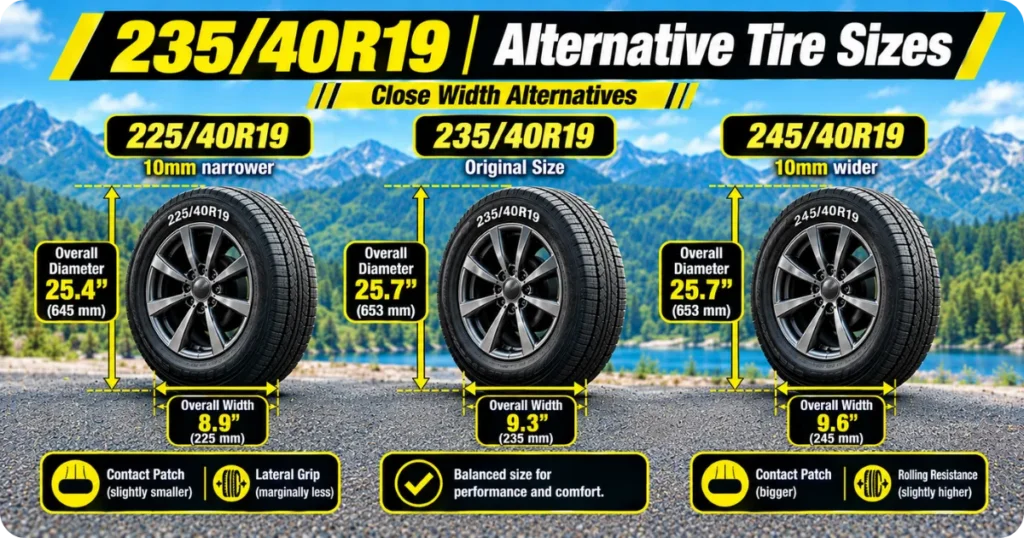
225/40R19 is 10mm narrower, with a slightly smaller contact patch and marginally less lateral grip. 245/40R19 is 10mm wider, giving a bigger contact patch but slightly higher rolling resistance.
Both usually stay within acceptable diameter tolerance, but confirm clearance against your suspension and wheel arch first.
The 3 Percent Diameter Rule
Any replacement size should stay within 3% of the original overall diameter. Go beyond that, and your speedometer accuracy suffers. Worse, some vehicles’ ABS and stability control systems get confused, since they calibrate against expected wheel rotation speed.
235/45R19 has a taller sidewall and often lands right at the edge of that 3% window, so always run the numbers before buying.
Staggered Fitments
Many performance cars in this size class, think RWD and AWD sport sedans, run a staggered setup: a narrower tire up front, a wider one in back. This improves rear traction under power.
If your car came with 235/40R19 up front, don’t assume the rear takes the same size. Check both axles on the placard separately.
Cost, Buying & Maintenance Tips
Real Total Cost
Budget all-season options in this size start around $100 to $150 per tire. Mid-range grand touring tires run $200 to $280. Premium UHP summer and performance tires climb past $300, sometimes well past it for track-focused rubber.
On top of the tire price, expect mounting and balancing fees, a disposal fee for your old tires, and sales tax. A full set of four can easily add $80 to $150 beyond the sticker price.
Low-Profile Road Risks
A 3.7-inch sidewall doesn’t leave much cushion between your rim and a pothole. Hit a deep one hard, and you risk a bent rim or a sidewall bulge that ruins the tire outright.
Curb rash is another common issue, since there’s less rubber to protect the wheel edge. Drive a little more cautiously around rough pavement and tight parking spots with this size.
TPMS and Sensor Resets
If you’re switching wheel or tire sizes, your TPMS (tire pressure monitoring system) may need a relearn or resensor procedure. Skip this step, and you could end up with a dashboard warning light that won’t clear, even though your tires are fine.
Rotation and Wear Checks
Rotate 235/40R19 tires every 5,000 to 7,500 miles to even out wear. Because the sidewall is short, tread wear shows up faster and more visibly than on taller tires.
Check tread depth monthly with a simple penny test or a tread depth gauge, and get an alignment check any time you notice uneven wear across the tread face.
Buying Online vs Local Install
Buying online often saves money upfront, but confirm the retailer partners with a local installer before you order. Otherwise you’re stuck finding your own shop, and not every tire shop will mount tires they didn’t sell you without extra fees.
More Posts: 225/65R17 Tire Size
FAQ’s About 235/40R19 Tire Size
Does my car actually take a 235/40R19 tire?
Check the tire placard inside your driver’s door jamb, or your owner’s manual. Both list the exact OEM size, along with the minimum load index and speed rating your vehicle requires. Don’t rely on general fitment lists alone, since trim variants can differ.
What load index and speed rating do I need for this size?
Most vehicles running 235/40R19 as original equipment need a load index of 92 or 96, which supports roughly 1,389 to 1,565 pounds per tire. Speed ratings typically range from V to Y depending on the trim. Never install a tire rated below your vehicle’s minimum requirement.
Can I mount a 235/40R19 on any 19-inch wheel?
Not quite. The 19-inch diameter is fixed, but the wheel’s width also matters. Stick to the 8.0 to 9.5-inch recommended range. You’ll also need to confirm the wheel’s offset and backspacing match your vehicle’s hub before it’ll fit correctly.
What’s the difference between V, W, and Y speed ratings here?
A V rating certifies sustained speeds up to 149 mph. A W rating goes up to 168 mph. A Y rating covers up to 186 mph and shows up on the highest-performance trims in this size. Match or exceed whatever your door placard specifies.
Is 235/40R19 a good winter tire size, or do I need a separate set?
A summer or UHP tire in this size isn’t safe below roughly 45°F, since the compound stiffens and grip drops. In climates with real winter weather, ice, heavy snow, or sustained sub-freezing temperatures, mount a dedicated winter tire on its own wheel set instead of relying on an all-season alone.
Can I switch to 225/40R19 or 245/40R19 without issues?
In most cases, yes, both stay close enough in overall diameter to avoid speedometer or ABS calibration problems. Still, run any size change through a tire size calculator first, and double-check that a wider tire like 245/40R19 clears your suspension and wheel arch before buying.

I’m Richard Hayes, a content researcher and writer at TireMeasurements.com, specializing in measurements, tire measurements, tire sizing, wheel fitment, and related automotive topics.