That’s the short answer. Below, we break down what this size means, which cars use it, which tires are worth buying, and how to keep them running longer.
If you’re standing in a driveway squinting at your old tire’s sidewall, this guide will save you a trip to the shop just to ask “what size do I need?“
What Is a 215/60R16 Tire?
Every tire size is really a code. Once you know how to read it, you’ll never need to guess again.
How to Read the 215/60R16 Code
- 215 — the tire’s width in millimeters, measured sidewall to sidewall
- 60 — the aspect ratio, meaning the sidewall height equals 60% of the tire’s width
- R — radial construction, the standard build for nearly all modern tires
- 16 — the wheel diameter in inches the tire is designed to fit
So a 215/60/16 tire is 215mm wide, has a sidewall that’s 60% as tall as it is wide, uses radial construction, and mounts on a 16-inch wheel. Simple math, once you know the pattern.
215/60R16 Tire Size At a Glance
| Measurement | Imperial | Metric |
|---|---|---|
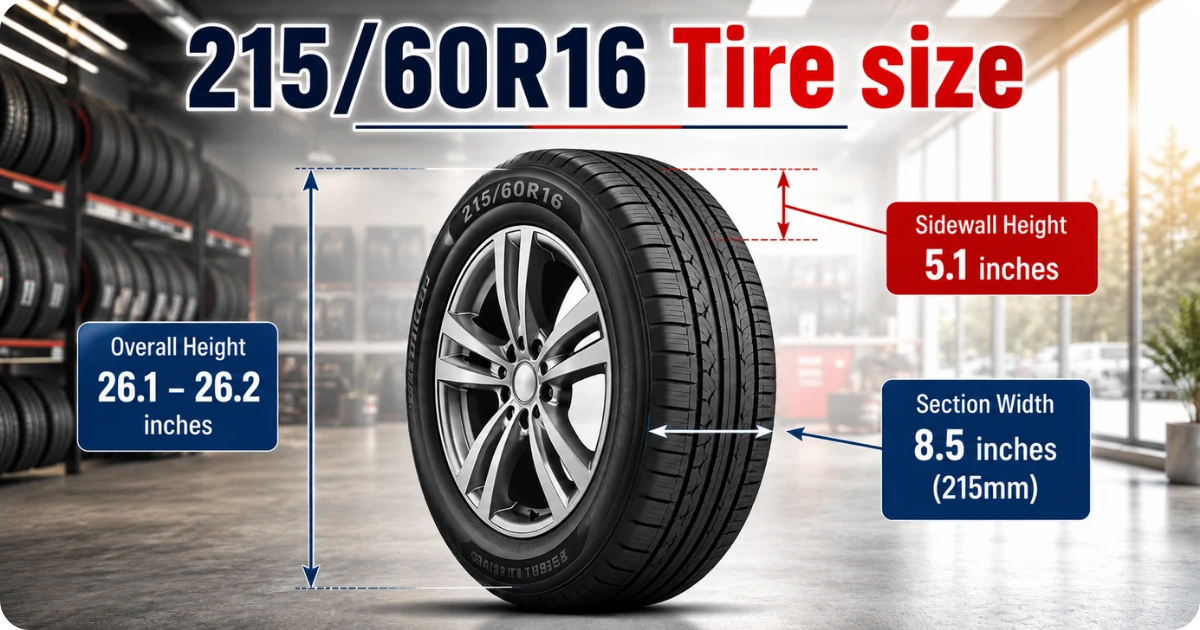
| Overall Diameter | 26.1–26.2 in | 664–664.4 mm |
| Circumference | 82.1–82.2 in | 2085–2087 mm |
| Section Width | 8.5 in | 215 mm |
| Sidewall Height | 5.1 in | 129 mm |
| Radius | 13.08 in | 332 mm |
A tire this size completes about 771 to 797 revolutions per mile, depending on the brand. That number might sound like trivia, but it directly affects your speedometer accuracy and fuel mileage — more on that below.
Load Index, Speed Rating & Max PSI
Most 215/60R16 tires carry a load index of 95, which supports up to 1,521 pounds per tire at the recommended pressure. Max inflation typically tops out around 51 PSI, though your daily driving pressure should follow the number on your driver’s door jamb, not the tire’s max rating.
Speed ratings vary — you’ll commonly see H (130 mph) or V (149 mph) ratings on this size, matched to the vehicle’s factory specs.
Compatible Rim Width Range
A 215/60R16 tire fits wheels between 6 and 7.5 inches wide. Mounting it outside that range can distort the tire’s shape, hurt handling, and wear the tread unevenly.
This is one of those details competitors mention but rarely explain — a tire mounted too narrow “pinches” the sidewall inward, while one mounted too wide flattens the tread and reduces grip.
More Posts: 195/65R15 Tire Size
What Vehicles Use 215/60R16 Tires?
Sedans & Coupes
You’ll find this size as the factory fitment on the Honda Accord (2003–2018), Toyota Camry (2001–2018), Nissan Altima (2005–2025), and Ford Fusion (2013–2021).
These are some of the best-selling sedans in U.S. history, which is exactly why this tire size stays so widely available and affordably priced.
SUVs, Crossovers & Minivans
Smaller crossovers lean on this size too, including the Honda HR-V (2015–2023), Mazda CX-3 (2015–2025), and Suzuki Vitara (2015–2025).
On the minivan side, the Honda Odyssey and Toyota Estima have used it across multiple generations.
Best 215/60R16 Tires for Every Season & Budget
Best All-Season
All-season tires dominate this size, with roughly 97 models available industry-wide. They’re the right call for drivers in states without harsh winters — think most of the South, coastal California, or the mid-Atlantic.
Look for tread compounds rated for both wet and dry grip, since that balance is what “all-season” actually promises.
Best Winter/Snow
If you’re in snow country — the upper Midwest, New England, or mountain regions — a dedicated winter tire outperforms all-seasons by a wide margin below 45°F.
There are about 60 winter-specific models built in this size, using softer rubber compounds that stay pliable in freezing temperatures. All-season tires stiffen up in the cold and lose grip exactly when you need it most.
Best Budget vs. Premium Options
Budget tires in this size typically run $65 to $90 each, covering basic all-season needs for daily commuting. Mid-range tires land around $90 to $130, offering better tread life and quieter rides.
Premium options from top-tier brands can reach $140 to $180 per tire, with longer warranties and stronger wet-weather performance.
Top Brands to Consider
Michelin, BFGoodrich, and Firestone all produce well-reviewed options in 215/60R16. Michelin’s Defender line, for example, is known for high mileage ratings, while BFGoodrich’s Advantage T/A Sport balances comfort with responsive handling.
Comparing warranty mileage (often 60,000 to 85,000 miles) is one of the most practical ways to judge value between brands.
More Posts: 225/65R17 Tire Size
215/60R16 vs. Similar Tire Sizes
215/60R16 vs. 225/60R16
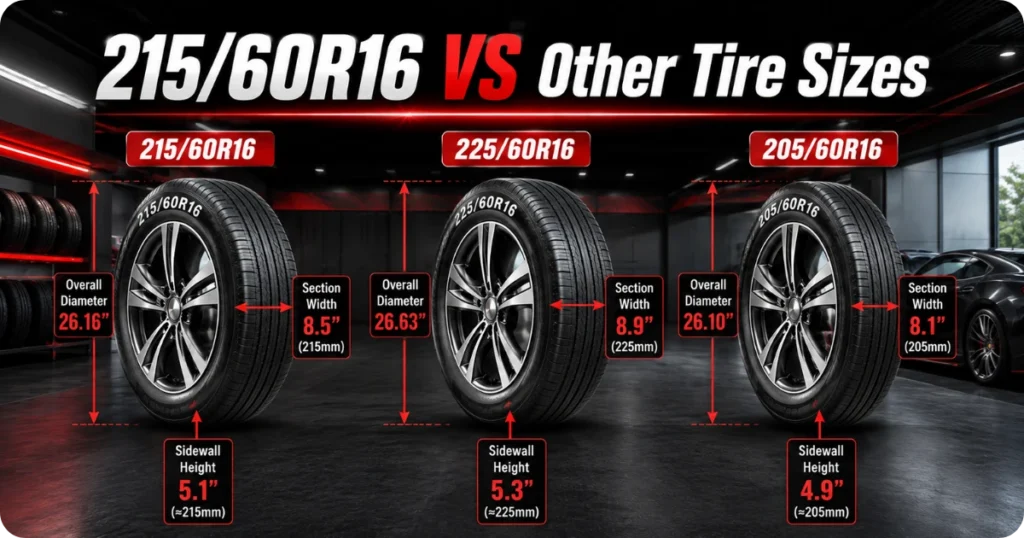
The 225/60R16 is 10mm wider and about 1.8% larger in overall diameter (26.63” vs. 26.16“). It offers marginally better traction from the wider contact patch, but slightly higher rolling resistance, which can nudge fuel economy down.
215/60R16 vs. 205/60R16
The 205/60R16 is 10mm narrower, with a diameter difference of less than 0.2% — nearly identical overall size. This narrower option suits drivers prioritizing fuel efficiency over outright grip.
215/60R16 vs. 215/55R17
Stepping up to a 215/55R17 keeps the width the same but drops the aspect ratio, landing on a nearly identical overall diameter (just 0.6% smaller) while fitting a larger 17-inch wheel. This is a classic “plus-size” swap for drivers who want a sportier look without changing how the car drives.
More Posts: 265/70R17 Tire Size
215/60R16 Tires FAQ’s
What are the dimensions of a 215/60R16 tire?
A 215/60R16 tire measures about 26.1 inches in diameter, 8.5 inches wide, with a 5.1-inch sidewall. Circumference runs roughly 82 inches.
How does the 215/60R16 tire size affect vehicle performance?
It affects speedometer accuracy, fuel economy, and handling feel. It’s built for a comfortable, balanced ride — switching away from this size without checking the 3% rule can throw off those readings.
What types of vehicles commonly use 215/60R16 tires?
Sedans like the Honda Accord and Toyota Camry, crossovers like the Honda HR-V, and minivans like the Honda Odyssey all use this size. It fits over 150 vehicle models total.
Are 215/60R16 tires available for all seasons?
Yes. There are all-season, winter, all-weather, and a smaller number of summer options available in this size, covering nearly every U.S. climate.
Can I replace my current tires with 215/60R16 if they’re a different size?
Yes, as long as the new size stays within 3% of your original tire’s diameter, your rim width fits (6–7.5 inches for this size), and the load index still meets your vehicle’s requirements.
How much does a 215/60R16 tire cost?
Budget models start around $65, while premium tires can reach $180 per tire, not including mounting and balancing.

I’m Richard Hayes, a content researcher and writer at TireMeasurements.com, specializing in measurements, tire measurements, tire sizing, wheel fitment, and related automotive topics.