If you drive a compact car, hatchback, or small sedan, you’ve probably seen 185/65R15 stamped on your tire’s sidewall. This number tells you the exact width, height, and rim fit your car needs — and getting it wrong can throw off your speedometer, ride quality, and even your brakes.
What Does 185/65R15 Mean?
Breaking Down Each Number
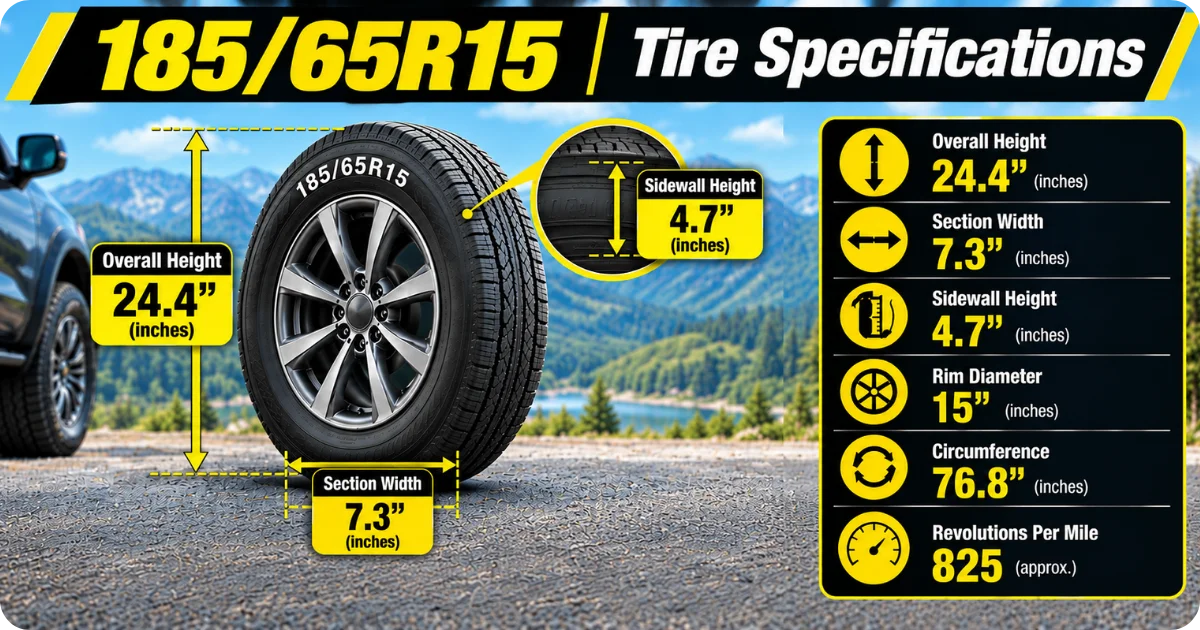
The first number, 185, is the tire’s width in millimeters, measured from sidewall to sidewall. That’s about 7.3 inches wide.
The second number, 65, is the aspect ratio. This is the tire’s sidewall height shown as a percentage of the width. Do the math: 185 x 0.65 = about 120mm, or roughly 4.7 inches tall.
The letter R simply means radial construction — the standard build for almost every passenger tire sold today.
The last number, 15, is the rim diameter in inches. This tire only fits a 15-inch wheel, not 14 or 16.
Overall Diameter and Sidewall Height
Add the wheel size and the two sidewalls together, and you get the overall diameter: about 24.4 inches, or 621mm. This number matters because it directly affects your speedometer accuracy and your car’s ground clearance.
You’ll also see a load index and speed rating after the size, like 88H. The load index 88 means each tire can safely carry about 1,235 pounds.
The speed rating H means the tire is rated for sustained speeds up to 130 mph. Most 185/65R15 tires carry an H, T, or S speed rating, since this size is built for everyday commuting, not racing.
More Posts: 195/65R15 Tire Size
What Cars Use 185/65R15 Tires?
Common US Models With This Size
In the American market, this size shows up on many older-generation compact cars and hatchbacks — think small Toyota, Honda, Hyundai, Nissan, and Chevrolet models from the last two decades.
It’s a popular fit because these cars are lighter and don’t need a wider contact patch to stay stable. This size is rarely found on trucks, SUVs, or performance cars, since those need wider tires for more grip and load capacity.
How to Confirm Your Tire Size
Don’t just guess based on a model name. Every vehicle has an official tire size listed in two places: the driver’s door jamb sticker and the owner’s manual. Your current tire’s sidewall is a third reliable source. Always match these three before buying.
Equivalent and Alternative Sizes for 185/65R15
Safe Upsize and Downsize Options
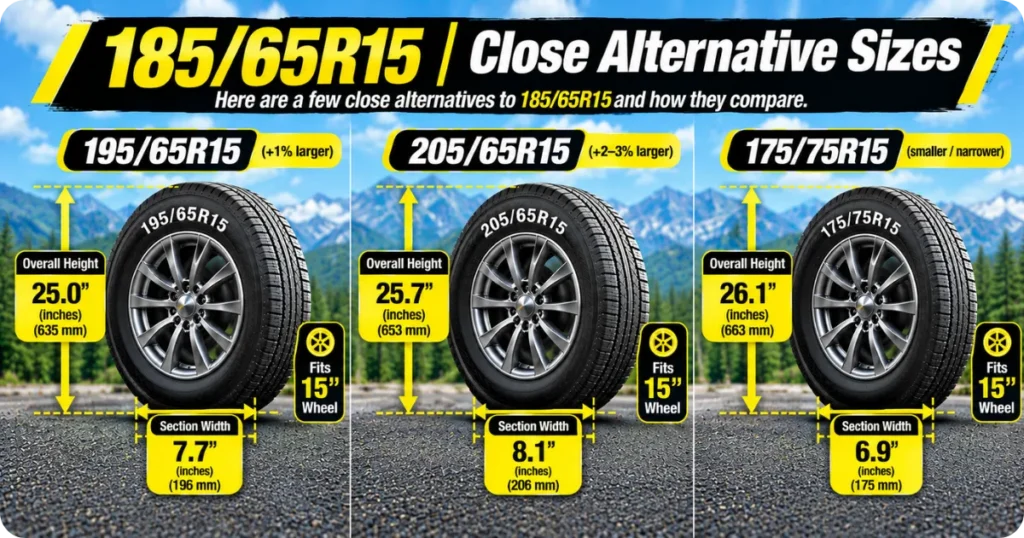
A few close alternatives to 185/65R15 include 195/65R15, which runs about 1% larger in diameter, and 205/65R15, which runs 2 to 3% larger. On the smaller end, 175/75R15 is an older, narrower option some vehicles were originally fitted with.
Tire experts generally recommend staying within plus or minus 3% of your original diameter. Anything beyond that range can cause rubbing, clearance issues, or inaccurate speedometer readings.
Why Diameter Match Matters
Your car’s speedometer, odometer, and anti-lock braking system (ABS) are all calibrated to your factory tire diameter. A tire that’s too big or too small changes how many times the wheel spins per mile, which throws off these systems — even if the tire physically fits under the fender.
More Posts: 225/65R17 Tire Size
How to Choose the Right 185/65R15 Tire
Season Type: All-Season, Winter, Summer
Most drivers with this size choose all-season tires, since compact cars in this category are usually daily commuter vehicles, not weekend performance cars.
If you live somewhere with heavy snow, a dedicated winter tire with the 3PMSF (three-peak mountain snowflake) symbol grips ice and snow far better than an all-season tire ever will.
Load Index, Speed Rating and Pressure
Never buy a tire with a lower load index than your factory-specified one. Doing so under-rates your car’s actual weight capacity. Stick with the speed rating your manufacturer recommends too — upgrading is fine, downgrading is not.
For cold tire pressure, most vehicles using 185/65R15 call for around 32 psi (2.2 bar), though you should always check your door-jamb sticker for your exact number.
Price Range and Tread Life
In the US market, 185/65R15 tires typically run between $55 and $135 per tire, depending on the brand tier and tread warranty.
Budget tires often carry a 45,000 to 60,000-mile warranty, while premium options can stretch to 80,000 or even 90,000 miles.
Since this is a smaller passenger size, it’s generally cheaper to replace than the larger sizes found on trucks and SUVs.
More Posts: 265/70R17 Tire Size
FAQ’s About 185/65R15 Tire
What does 185/65R15 mean?
185 is the tire’s width in millimeters, 65 is the sidewall height as a percentage of that width, R means radial construction, and 15 is the required wheel diameter in inches.
What is the overall diameter of a 185/65R15 tire?
The overall diameter is about 24.4 inches, or 621mm, once you account for the wheel size and both sidewalls.
What cars commonly use 185/65R15 tires?
This size is common on compact cars, hatchbacks, and subcompact sedans, especially older-generation models from Toyota, Honda, Hyundai, and Chevrolet. Always confirm with your door-jamb sticker.
Can I replace 185/65R15 with 195/65R15 or 205/65R15?
Yes, in most cases. 195/65R15 is about 1% larger, and 205/65R15 is about 2 to 3% larger. Both stay within the safe 3% diameter rule, but check for fender clearance first.
What is the correct tire pressure for 185/65R15?
Most vehicles need around 32 psi (2.2 bar) cold, but the exact number is always printed on your door-jamb sticker.
What is a good load index and speed rating for this size?
An 88 load index carries about 1,235 pounds per tire, and most tires in this size carry an H, T, or S speed rating. Never go below your car’s factory-recommended rating.
How much do 185/65R15 tires cost in the US?
Expect to pay between $55 and $135 per tire, depending on brand and tread warranty length.
Are 185/65R15 tires good for winter driving, or do I need dedicated winter tires?
Standard all-season tires in this size handle light snow, but a dedicated winter tire with the 3PMSF symbol performs significantly better in heavy snow and ice.
How do I find my car’s correct tire size?
Check the driver’s door jamb sticker, your owner’s manual, or the sidewall of your current tire. These three sources should always match.

I’m Richard Hayes, a content researcher and writer at TireMeasurements.com, specializing in measurements, tire measurements, tire sizing, wheel fitment, and related automotive topics.